Detailed explanation of the materials and production processes of vaccine bags
The selection of materials and the design of manufacturing processes for vaccine bags must balance biosafety, chemical stability, airtightness, barrier properties, and production efficiency. The following is a detailed explanation of vaccine bag materials and manufacturing processes:
.jpg)
I. Vaccine Bag Material Selection
Vaccine bags must meet the following core requirements:
Biosafety: No interaction with vaccine components; no release of harmful substances.
Chemical Stability: Resistant to sterilization processes (such as high temperatures, radiation, and chemical disinfectants) and long-term storage conditions.
Airtightness and Barrier Properties: Prevents microbial intrusion, gas permeation (such as oxygen and water vapor), and light penetration.
Mechanical Strength: Resistant to physical stresses (such as compression and puncture) during transportation, storage, and use.
Common Materials and Properties:
Fluoropolymer Film:
Types: Polytetrafluoroethylene (PTFE), polyvinylidene fluoride (PVDF), fluorinated ethylene propylene (FEP), etc.
Advantages: High temperature resistance, chemical corrosion resistance, low permeability, and excellent biocompatibility.
Applications: In COVID-19 vaccine packaging, fluoropolymer film is a key material to ensure the stability of the vaccine during transportation and storage.
Cyclic Olefin Copolymers (COC):
Characteristics: High transparency, strong water vapor barrier, excellent chemical resistance.
Applications: Used for pre-filled syringes and pharmaceutical packaging films, meeting the high purity requirements of vaccine packaging materials.
Composite Materials:
Structure: Multi-layer composite (e.g., paper-aluminum composite, plastic-aluminum foil composite).
Advantages: Combines the properties of different materials; for example, aluminum foil provides light and oxygen barrier, while the plastic layer enhances mechanical strength.
Applications: Aseptic packaging bags use a paper core layer (pure cotton or synthetic cellulose) combined with a silver ion antibacterial layer and a UV adsorption layer to achieve long-lasting antibacterial effect.
II. Vaccine Bag Manufacturing Process
The production of vaccine bags requires precise processes to ensure sealing and sterility. Key technologies include:
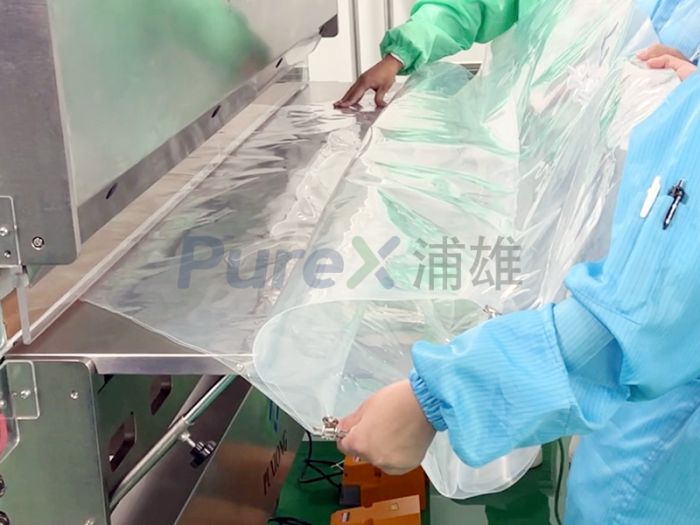
Heat-Sealing:
Principle: By heating the material at the sealing point to a viscous state and then applying pressure, molecular-level adhesion is achieved.
Applications: Widely used for sealing the sides and bottom of vaccine bags, relying on heat-sealing devices (e.g., flatbed heat sealing, pulse heat sealing). Key Parameters:
Temperature: Requires precise control to avoid material decomposition (e.g., PTFE melting point is approximately 327℃).
Pressure: Ensures sealing strength, typically 0.1-0.5 MPa.
Time: Related to material thickness; a balance must be struck between sealing quality and production efficiency.
Advantages: High sealing strength, excellent sealing performance, suitable for large-scale production.
Ultrasonic Welding:
Principle: Utilizes high-frequency vibration (15-70kHz) to generate heat through friction at the contact surfaces, achieving rapid fusion of amorphous materials.
Applications: Suitable for precision connections of valves or interfaces in vaccine bags; short welding cycle (milliseconds), no slag production.
Limitations: Sensitive to material crystallinity; semi-crystalline materials require near-field welding (distance from corner sleeve <6mm).
High-Frequency Welding:
Principle: Heats the film material using high-frequency electromagnetic waves; suitable for large-area welding or repair.
Applications: Used for straight-line sealing of PVC or composite films in pharmaceutical packaging, but the weld strength is slightly lower than hot-press welding (approximately 60% of the substrate strength). Aseptic Packaging Technology:
Multi-layer Composite Structure: Such as a paper core layer (pure cotton or synthetic cellulose) combined with a silver ion antibacterial layer and a UV adsorption layer; a rigid plastic outer layer enhances mechanical strength; and an aluminum foil inner layer blocks light and oxygen penetration.
Anti-counterfeiting Design: Dyed anti-counterfeiting tape is placed on the inside of the opening edge; once opened, the glue transfer mark cannot be restored.
Piercing Rod and Transition Tube Design: Enables sealed liquid storage and retrieval; a raised structure fixes the straw position.