Detailed Explanation of Negative Pressure Drainage Bottles and Their Production Equipment: High-Frequency Welding Machine
Introduction
In modern medicine, negative pressure drainage technology has been widely used in surgical and treatment procedures, particularly for patients with trauma, tumors, and inflammation, demonstrating significant effectiveness in draining fluid and changing dressings. As the core component of a negative pressure drainage system, the quality and performance of the negative pressure drainage bottle directly affect patient safety and treatment outcomes. This article will provide a detailed introduction to the working principle, structural characteristics, and high-frequency welding machine used in the production of negative pressure drainage bottles, aiming to provide a reference for research and production in related fields.
I. Working Principle and Structural Characteristics of Negative Pressure Drainage Bottles
1. Working Principle
A negative pressure drainage bottle is a device that utilizes the negative pressure difference generated by a vacuum pump, connected to a suction device via a pipe, to drain fluid from wounds or lesions and facilitate dressing changes. When the negative pressure drainage bottle is connected to the suction device, the vacuum pump starts working, drawing out the gas inside the container and creating a negative pressure difference. This negative pressure difference guides the fluid from the wound or lesion outwards, thus achieving the purpose of drainage. Simultaneously, when changing dressings, simply place the new dressing into the negative pressure drainage bottle; the negative pressure difference will automatically adhere the dressing, facilitating the doctor's operation.
2. Structural Features
The negative pressure drainage bottle mainly consists of the following parts: bottle body, sealing ring, suction head, filter, and liquid level indicator. The bottle body is cylindrical, with an outlet and inlet at the bottom; the sealing ring ensures the bottle's airtightness; the suction head is conical and can be connected to pipes of different diameters; the filter removes impurities from the liquid; and the liquid level indicator monitors the liquid level in the bottle in real time.
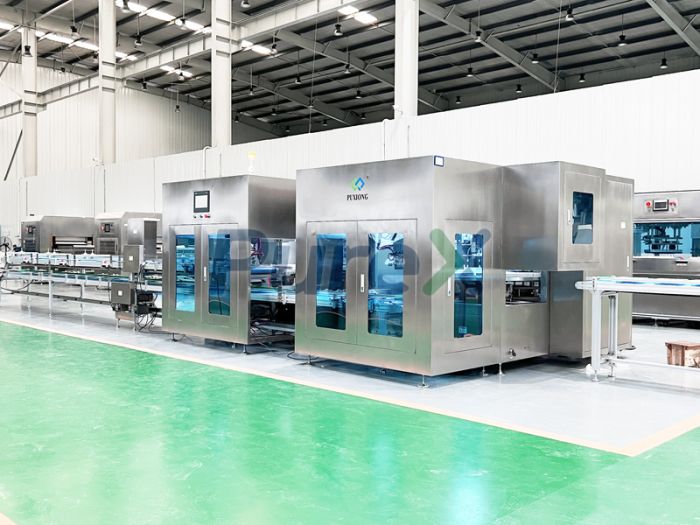
II. Detailed Explanation of the High-Frequency Welding Machine for Negative Pressure Drainage Bottle Production
1. Working Principle of the High-Frequency Welding Machine
The high-frequency welding machine is a device that uses high-frequency current to instantly heat metal materials to a molten state, and then applies pressure to fuse the metal together. In the production process of negative pressure drainage bottles, the high-frequency welding machine is mainly used for heat treatment of the bottle body, giving it better sealing and tensile strength.
2. Structural Features of a High-Frequency Welding Machine
A high-frequency welding machine mainly consists of the following parts: a power module, an induction coil, a workpiece fixture, a cooling system, and a control system. The power module provides stable voltage and current to the high-frequency welding machine; the induction coil generates a high-frequency electromagnetic field, causing the workpiece to heat up; the workpiece fixture is used to fix the negative pressure drainage bottle to be processed; the cooling system is used to reduce the temperature of the workpiece and prevent overheating and deformation; the control system is responsible for controlling the working status of each part to achieve automated production.
3. How to Use a High-Frequency Welding Machine
When using a high-frequency welding machine to heat-process a negative pressure drainage bottle, the following steps should be followed: First, place the negative pressure drainage bottle to be processed on the workpiece fixture; then place the induction coil on the surface of the bottle, ensuring there is no air gap between the coil and the bottle; next, start the high-frequency welding machine, adjust the current and heating time to ensure the bottle is fully heated; finally, apply pressure to fuse the metal together, completing the heat processing of the bottle. Throughout the process, it is necessary to carefully control the heating temperature and time to avoid overheating that could cause deformation or damage to the bottle.
Conclusion: As a core component of negative pressure drainage systems, the quality and performance of negative pressure drainage bottles directly affect patient safety and treatment outcomes. This article provides a detailed explanation of the working principle, structural characteristics, and high-frequency welding equipment used in the production of negative pressure drainage bottles, hoping to offer a reference for research and production in related fields. With the development of science and technology and the advancement of medical technology, it is believed that negative pressure drainage bottles will play an important role in more clinical applications.