What are the advantages and features of high-frequency heat sealing machines
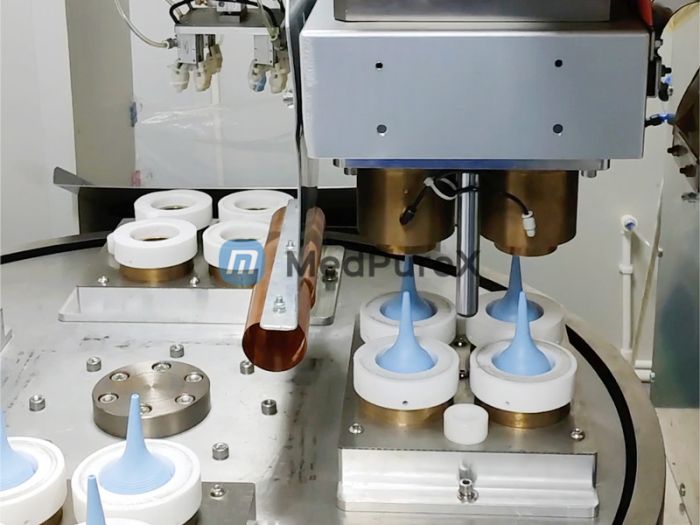
High-frequency heat sealing machines, with their unique working principle and technical characteristics, demonstrate significant advantages in the medical device manufacturing field, especially suitable for products requiring high precision, high cleanliness, and complex processes. The following is a detailed analysis of their core advantages and features:
I. Core Advantages
High Efficiency and Energy Saving, Leading Production Speed
Rapid Heating and Cooling: High-frequency heat sealing machines directly act on material molecules through a high-frequency electromagnetic field, achieving millisecond-level heating without preheating or prolonged heat preservation, significantly shortening the production cycle. For example, the heat sealing time for producing a medical infusion bag can be controlled within 1-3 seconds, far exceeding the efficiency of traditional heat sealing equipment.
Low Energy Consumption Design: Energy is concentrated on the material contact surface, reducing heat loss. Overall energy consumption is 30%-50% lower than traditional equipment, meeting the green production requirements of the medical device industry.
Precision Control, Strong Quality Stability
Adjustable Parameters: Precise control of parameters such as frequency (e.g., 27.12MHz, 13.56MHz), power, pressure, and time is possible to adapt to the processing needs of different materials (PVC, PE, TPU, etc.) and thicknesses (0.1mm-5mm). For example, in catheter welding, molecular-level fusion can be achieved by adjusting the frequency, ensuring that the sealing strength meets standards.
Consistency Guarantee: Automated control systems reduce human intervention, increasing product qualification rates to over 99%, making it particularly suitable for large-scale standardized production.
Non-contact Processing, Ensuring Hygiene and Safety
No Contamination Risk: High-frequency electromagnetic fields act directly on the material's interior, eliminating the need for mechanical pressure or chemical adhesives. This avoids problems such as material deformation and residue contamination that can occur with traditional hot pressing, meeting the high requirements of medical devices for a sterile environment.
Suitable for Sensitive Materials: Can handle heat-sensitive materials (such as certain medical films), preventing overheating or scorching through optimized parameters.
Multi-functional Integration, Adapting to Complex Processes
Integrated Welding, Cutting, and Embossing: One machine can perform multiple operations. For example, in the production of medical isolation gowns, fabric welding, edge cutting, and brand logo embossing can be performed simultaneously, reducing process changeover time.
Wide Compatibility: Supports the processing of flat, curved, and irregularly shaped products, such as welding balloon catheters and welding complex structures in anti-decubitus air cushions.
II. Technical Features
High-Frequency Electromagnetic Field Heating Principle
Molecular-Level Frictional Heating: High-frequency current (typically 27.12MHz) causes material molecules to vibrate at high speed, generating frictional heat for welding. This heating method is uniform and deep, ensuring consistent weld layer thickness and higher strength.
Deep Heating Capability: Compared to traditional heat conduction methods, high-frequency heating can penetrate the material surface, achieving uniform internal melting, especially suitable for processing multi-layer composite materials.
Automation and Intelligent Control
PLC + Touchscreen Operation: Equipped with a programmable logic controller (PLC) and a human-machine interface (HMI), supporting parameter storage, fault diagnosis, and remote monitoring, lowering the operational threshold.
Sensor Feedback System: Real-time monitoring of key parameters such as temperature and pressure, automatically adjusting output power to ensure stable and controllable processing.
Modular Design, Convenient Maintenance
Quick Mold Change Function: Standardized mold design reduces changeover time to within 10 minutes, adapting to the needs of multi-variety, small-batch production.
Long Lifespan of Wear Components: Core components such as high-frequency oscillator tubes and capacitors have a lifespan of over 5 years, reducing downtime for maintenance.
Comprehensive Safety Protection Mechanism
Multiple protection devices: including overload protection, leakage protection, and high-frequency radiation shielding, ensuring operator safety.
Compliant with International Standards: Certified by CE, ISO13485, etc., meeting the stringent compliance requirements of the medical device industry.
III. Typical Application Scenarios in the Medical Device Industry
Disposable Medical Supplies Production
Infusion Bags/Blood Bags: High-frequency heat sealing achieves seamless sealing of blood bags, with a leakage rate of less than 0.01%, far exceeding industry standards.
Urinary Catheter Bags/Drainage Bags: Precise control of welding temperature prevents material embrittlement, extending product lifespan.
Catheter and Tube Processing
Balloon Catheter Welding: High-frequency energy fuses the balloon and catheter materials into a high-strength connection, withstanding high-pressure testing.
Transfusion Tube Sealing: Non-contact heating prevents heat-induced denaturation of blood components, ensuring biocompatibility.
Medical Packaging Solutions
PVC Blister Box Sealing: High-frequency heat sealing achieves glue-free bonding, avoiding the risk of chemical migration and meeting FDA requirements for food and drug packaging.
Multi-layer liquid bag lamination: By adjusting the frequency, different material layers are welded together, improving the packaging's barrier properties.
Specialty medical supplies manufacturing:
Anti-decubitus air cushion: High-frequency welding technology ensures uniform sealing of all parts of the air cushion, preventing deformation under long-term pressure.
Medical ice pad: By precisely controlling the welding depth, uniform distribution of gel within the ice pad is achieved, enhancing the cooling effect.